 Certified SDVOSB · Global Management Consulting Since 2009
Introducing the cornerstone of the HRS Consulting AI Practice—bridging the gap between static governance frameworks and the real-world operational stress of live artificial intelligence.
The AI Governance Gap: Launch Certificates vs. Continuous Operations
Every business leader today is confronting the same dual reality: the undeniable promise of artificial intelligence and the paralyzing fear of its failure.
To manage this, organizations have eagerly adopted popular AI governance frameworks. Leading models—such as the NIST AI Risk Management Framework (RMF), VA Trustworthy AI Framework, Gartner’s AI TRiSM, and proprietary methodologies from Deloitte, McKinsey, and PwC—do an excellent job of defining what good AI governance requires. They outline principles, list requirements, and establish gates for approving AI systems.
But here is the hard truth: governance frameworks are launch certificates dressed as operating models.
They tell you how to approve an AI system on day one. They are comparatively silent on how to run that system on day 100, day 300, or day 1,000—when the model, its underlying data, and the operational environment have silently drifted. They do not account for the quiet between incidents, the complacent operator, or the covert failure that hides in plain sight.
This operational gap is exactly what HRS Consulting is built to close. By porting decades of rigorous discipline from High Reliability Organizations (HROs)—historically proven in aviation, nuclear power, and healthcare—we have designed a universal, executable operating model: HRS4AI (The High-Reliability Standard for Artificial Intelligence).
Why AI Breaks Classic HRO Assumptions
Classic HRO theory was built for high-hazard, human-operated systems like air traffic control and nuclear reactors. However, we cannot simply copy-paste classic HRO rules into the AI era. Classic HRO relies on four load-bearing assumptions that AI completely breaks:
- Failures announce themselves: In traditional engineering, a physical part breaks and causes a visible warning. In AI, failures go silent. Performance drift, bias accumulation, and confident hallucinations disguise themselves as perfectly normal operation.
- The operator is attentive and skilled: With automation, human operators naturally drift into automation complacency and deskilling. When a system fails, the operator must suddenly take over while surprised, disoriented, and unprepared.
- The system’s logic can be interrogated: Classic HRO relies on “deference to expertise”. But if an AI system is an opaque “black box,” even the most experienced domain expert cannot interrogate its reasoning in real-time, effectively disabling human oversight.
- The hazard is stable: Unlike a stable physical reactor, the AI hazard moves. Models retrain, underlying data shifts, and regulatory standards are in constant flux (such as the rapid transition from OMB M-24-10 to M-25-21).
Furthermore, AI introduces entirely new risk surfaces that classic HRO never had to contend with—including adversarial attacks, prompt injections, data poisoning, and complex supply-chain provenance.
HRS4AI is the specific operating method designed to solve these exact failure modes across any sector.
The Lifecycle Spine: A Continuous Loop
At the heart of the HRS4AI Operating Model is a single foundational claim: reliability is a dynamic, not a state. An AI system is never “certified safe”; it is only kept safe through an uninterrupted, closed-loop lifecycle of six distinct stages:
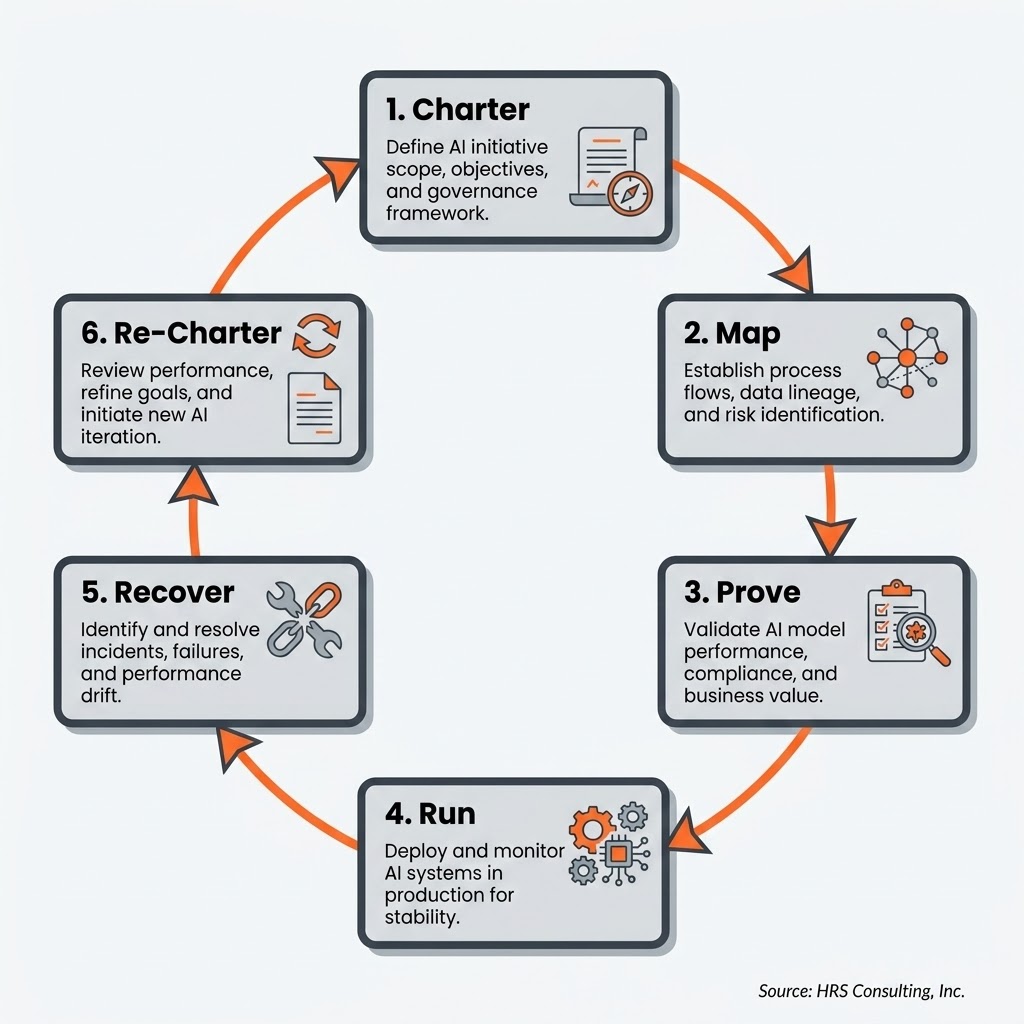
- Charter: Establish a clear business benefit, identify accountable owners, define override rights, and set operating policies.
- Map: Risk-tier the system, build a live inventory of models and data, and characterize direct and indirect impacts on stakeholders.
- Prove: Rigorously evaluate the system against trustworthy characteristics (accuracy, robustness, fairness, explainability, security, and privacy) and design a functional human-fallback path before launch.
- Run: Operate under continuous assurance, utilizing active drift and bias monitoring, live near-miss reporting, and deliberate operator-engagement practices.
- Recover: Execute safe degradation, version rollback, action-undo, and capture documented learnings when a model leaves its competence envelope.
- Re-Charter: Every material change, runtime incident, or scheduled assessment re-opens the charter. The loop never terminates.
Mapped 1:1 to the NIST AI RMF
HRS4AI is completely standard-agnostic. To ensure seamless integration with your existing compliance efforts, the six-stage spine is mapped directly to the four core functions of the NIST AI Risk Management Framework:
| HRS4AI Lifecycle Stage | NIST AI RMF Function | What It Guarantees |
|---|---|---|
| Charter | Govern | Absolute clarity on purpose, accountability, decision rights, and policy. |
| Map | Map | Precise context, risk tiering, model/data inventory, and impact analysis. |
| Prove | Measure | Thorough pre-deployment evaluation across all trustworthy dimensions. |
| Run | Manage | Real-time continuous assurance of the live running system. |
| Recover | Manage | Rapid response, safe rollback, safe-stop, and documented organizational learning. |
This structure means that whether your organization uses NIST, ISO/IEC 42001, the VA Framework for Trustworthy AI, or custom internal principles, HRS4AI serves as the executable layer that sits beneath and operationalizes those standards.
The Six Reliability Disciplines
To translate these high-level principles into daily operational reality, HRS4AI establishes Six Reliability Disciplines. Each discipline owns a specific corporate process, a defined control artifact, and targets critical AI vulnerabilities:
- D1 — Chronic Unease (Preoccupation with Failure): We assume the model is actively degrading until proven otherwise. This discipline establishes continuous drift and error surveillance on live outputs, alongside an aviation-style near-miss and incident register.
- D2 — Refusal of the Clean Answer (Reluctance to Simplify): A highly fluent, confident AI output is not evidence of correctness. We preserve the healthy doubt that allows domain experts to challenge and overturn machine decisions, supported by recurring, lifecycle-wide bias and fairness testing.
- D3 — Govern the Running System (Sensitivity to Operations): We govern the model that is actually running in production, not the “perfect” model that was approved months ago. This requires maintaining a live, automated AI inventory, executing regular “shadow AI” sweeps, and implementing active operator practices to combat automation complacency.
- D4 — Designed Recovery (Commitment to Resilience): We believe that “safe to deploy” is meaningless without “safe to stop.” Before any model is launched, we engineer a clear fallback path, safe-to-stop mechanisms, and model-version rollbacks. Crucially, we rehearse these recovery procedures through live drills rather than just documenting them on paper.
- D5 — Authority to Stop (Deference to Expertise): Accountability cannot be automated. This discipline names a single accountable human owner at the Charter stage and ensures that the human overseer has the formal authority, time, and standing to override or completely halt the AI system in real-time.
- D6 — New-Surface Defense: Acknowledging that traditional HRO is weakest in cybersecurity, this discipline establishes a dedicated, honest handoff to security partners. It mandates adversarial testing (red-teaming), privacy-by-design, data minimization, and supply-chain provenance checks for foundation and third-party models.
Governing at Machine Speed: The Agentic AI Layer
As systems transition from advisory tools to autonomous agents that act, transact, and chain actions independently, they introduce a terrifying risk: the loss of human control over an acting system.
HRS4AI addresses this by treating agentic AI as its own distinct control layer, enforcing Five Non-Negotiable Controls that scale strictly in proportion to the agent’s Autonomy Tier (A0 to A3):
- A0 — Advisory (Human decides and acts): Requires basic transactional logging.
- A1 — Recommend-with-Approval (Human commits): Requires logging and a functional kill switch.
- A2 — Act-Within-Bounds (Acts inside hard limits): Enforces immutable logging, a kill switch, hard action boundaries (e.g., maximum transaction limits), and rapid action rollback.
- A3 — Autonomous (Acts and chains independently): Mandates all A2 controls, plus real-time anomaly detection, fully rehearsed rollback drills, and a defined human escalation path, backed by board-level visibility.
Two Scales, One Backbone: How We Integrate with Enterprise IT
The true brilliance of the HRS4AI model is that it does not force your organization to learn a new corporate language. It integrates AI directly into your existing IT operations through one shared enterprise Impact/Severity backbone.
We hang two distinct, ITIL-aligned scales off this single backbone:
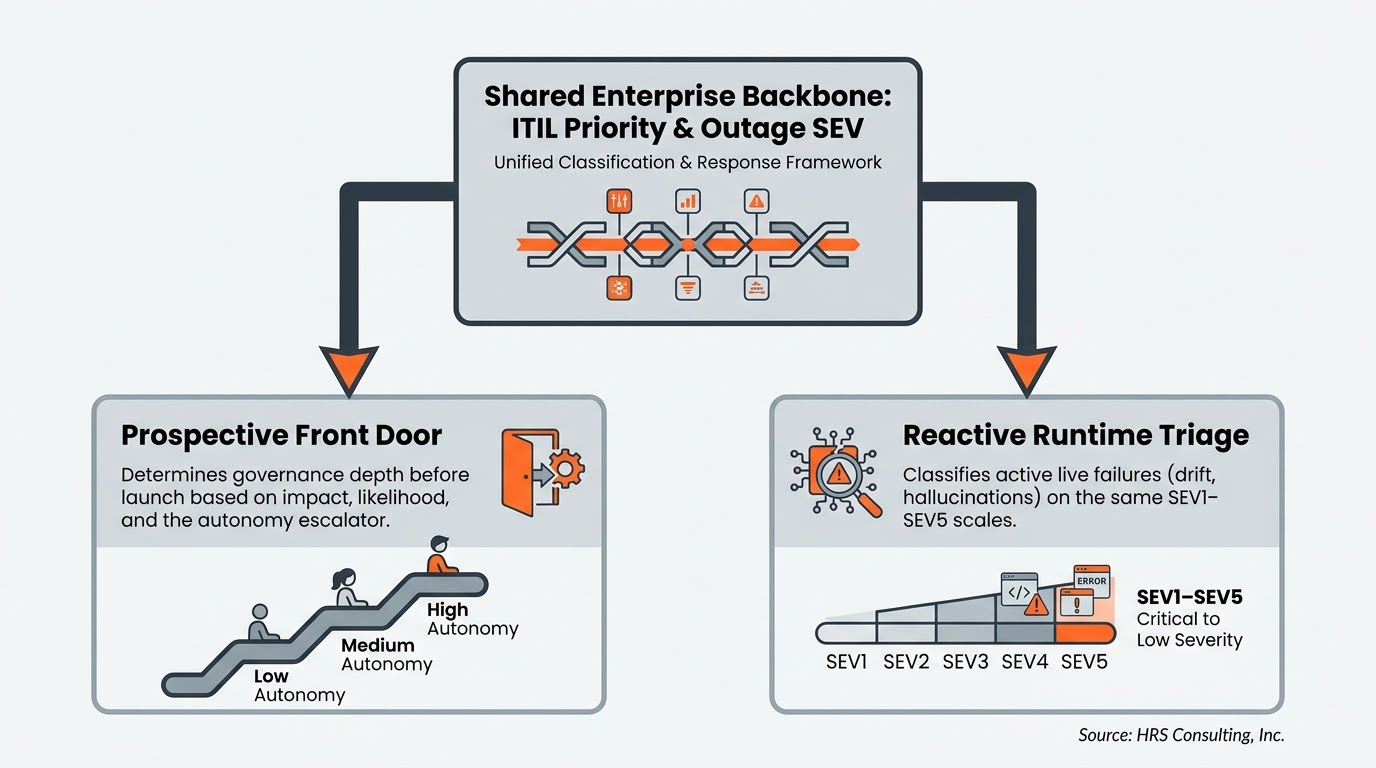
This dual-scale approach allows your security, IT, risk, and AI development teams to communicate seamlessly using the exact same metrics. If a live AI model suffers a critical drift breach or begins generating harmful hallucinations, it is immediately triaged as a SEV1 or SEV2 major incident, routing it through the same high-urgency major-incident process as an enterprise network outage.
The Cornerstone of the HRS Consulting AI Practice
At HRS Consulting, we do not sell abstract principles or generic advice. We partner with organizations to operationalize high-reliability AI through a structured, repeatable engineering discipline.
Our AI Practice works with clients across four decisive moves:
- Adopt Your Reference Standard: We map the HRS4AI spine directly beneath your chosen regulatory or internal compliance framework (such as NIST AI RMF, ISO 42001, or the VA six principles).
- Deploy the Risk-Tiering Front Door: We scan and risk-tier your entire AI estate against your existing enterprise severity scales, automatically applying the appropriate level of governance.
- Score the Five-Rung Maturity Ladder: Using our proprietary diagnostic assessment, we score your organization across all six disciplines (from Unaware to Self-Correcting). This generates a precise, customized Maturity Profile and a concrete, actionable roadmap with owners and clear timelines—producing artifacts, not slogans.
- Stand Up the Loop: We instrument your live environment for continuous assurance (Run), establish an aviation-inspired “Just Culture” where teams are incentivized to report near-misses, and systematically rehearse fallback and recovery drills (Recover).
Move from Static Compliance to Dynamic Reliability
AI governance is not a check-the-box certification exercise. If your models are running, your governance must be running too.
HRS4AI is the path to achieving true, sustained reliability under the real-world operational stress of live AI deployment. Let’s move your enterprise beyond static launch certificates and build an operating model engineered to survive the unexpected.
To learn more about how HRS Consulting can baseline your organization’s AI maturity and establish a high-reliability operating model, contact our AI Practice team today.